The Kitchen That Almost Broke Her
Sarah Martinez stood in her 1980s kitchen at 2 AM, scrolling through her phone with tears of frustration in her eyes. The laminate countertops were peeling. The cabinet doors hung at odd angles. The linoleum floor had seen better decades.
She'd saved $8,000 over two years for this renovation. But three contractors had already given her quotes between $25,000 and $38,000—money she simply didn't have. The fourth contractor never called her back.
She had two choices: give up on her dream kitchen, or figure it out herself. The problem? Sarah had never renovated anything more complicated than painting a bedroom. She didn't know the difference between drywall anchors and toggle bolts. She couldn't tell you what "backerboard" was or why it mattered.
This is the moment where most people either abandon their projects or make expensive mistakes that cost more than hiring a professional would have in the first place.
But Sarah's story—and the story of millions of homeowners like her—just took an unexpected turn.
When Big Box Retail Meets Artificial Intelligence
Home Depot, the $150 billion home improvement giant, just deployed something that sounds like science fiction but is rolling out to stores right now: an AI assistant that can walk a complete novice through an entire renovation project, from the terrifying "I don't even know where to start" phase all the way to a comprehensive materials list with aisle-by-aisle directions inside your local store.
They call it Magic Apron. And the name, while a bit whimsical, undersells what's actually happening here.
This isn't a chatbot that gives you generic advice and wishes you luck. This is a sophisticated AI system powered by Google Cloud's Gemini models that understands context, remembers what you're trying to accomplish, and guides you through complex projects with the kind of expertise you'd expect from a 20-year veteran of home renovation.
You describe your project in plain English—the same way you'd text a knowledgeable friend. "I want to retile my bathroom shower but I've never done tile work before." And it responds not with a link to a how-to article, but with a conversation that walks you through every decision point, every material choice, and every potential pitfall.
The Technology That Knows What You Forgot
Here's where Magic Apron gets genuinely impressive.
Let's say you're planning to install a new backsplash in your kitchen. You tell the AI your plan: glass tile, subway pattern, behind the stove and sink.
A traditional search would give you results about glass tiles. Maybe some installation videos. You'd be on your own to figure out the rest.
Magic Apron does something different. It tells you that glass tiles require either unsanded grout or epoxy grout (because sanded grout will scratch the surface). It asks about your tile size to calculate how much grout you'll need. It reminds you that you'll need tile spacers, a notched trowel (and specifies which notch size based on your tile), a wet saw or tile cutter, and safety glasses.
Then it tells you exactly which aisle and bay in your local store carries each item.
But here's the detail that matters most: it flags the things you didn't know you needed. The grout sealer you would have forgotten. The backerboard if you're tiling over drywall in a wet area. The membrane if you're working in a shower.
These aren't upsells. These are the materials that separate a successful DIY project from a disaster that costs twice as much to fix.
How People Are Actually Using This Right Now
The technology exists in two forms, both expanding rapidly across Home Depot's ecosystem.
For Everyday Homeowners: The In-Store Experience
The in-store version of Magic Apron is currently being tested at select locations, with a nationwide rollout planned for the coming months. Early users describe an experience that feels like having a knowledgeable store associate who never gets tired, never gets pulled away to help another customer, and has instant access to the location of every product in the building.
You can approach a kiosk (or eventually use your phone inside the store) and describe what you're trying to accomplish. The AI asks clarifying questions, makes recommendations, and creates a shopping path through the store that's optimized for your specific project.
One beta tester described using it for a deck repair project: "I told it I had boards that were rotting and needed to replace them. It asked me about the size of my deck, what the wood looked like, whether it was painted or stained. Then it gave me a complete list—not just the deck boards, but the screws, the drill bits, the stain, the brushes, even the sandpaper I'd need to prep the surface. It knew things I didn't know I needed to know."
For Contractors and Serious DIYers: The Pro Materials List Tool
On the professional side, Home Depot launched an AI-powered materials list tool that went into beta in November 2025 and is now rolling out nationally.
This version is designed for people tackling larger projects or managing multiple jobs. You can describe the project by voice or text, or even upload a list of materials you've already compiled, and the AI builds out a comprehensive, organized materials list.
The system groups items logically (all your electrical supplies together, all your plumbing fixtures together), calculates quantities based on your project scope, and identifies gaps in your planning.
A small contractor in Atlanta described using it for a bathroom renovation: "I dictated the project while I was driving between job sites. By the time I got to Home Depot, I had a complete list waiting for me, organized by department. It caught two things I'd forgotten—a shutoff valve for the toilet and extra tile for cuts and mistakes. That alone probably saved me a trip back to the store."
The Democratization of Expertise
What Home Depot has built here is bigger than a shopping tool. This is the democratization of expert knowledge.
For decades, there's been a massive information asymmetry in home improvement. Professionals know things that homeowners don't. They know which materials work together. They know which shortcuts are safe and which ones will cause problems. They know what building codes require. They know how much extra to buy for waste and mistakes.
This knowledge gap is why contractors can charge premium rates. It's also why DIY projects fail so often—not because homeowners lack the physical ability to do the work, but because they lack the knowledge to plan it correctly.
Magic Apron doesn't eliminate the value of professional expertise, but it does make basic competence accessible to everyone. It's like the difference between not knowing how to cook and having a skilled chef guide you through a recipe step-by-step. You're still doing the work, but you're no longer guessing.
The Real-World Economics Are Staggering
Let's return to Sarah and her kitchen renovation for a moment.
With contractor quotes ranging from $25,000 to $38,000, and her budget sitting at $8,000, she was facing a simple reality: her kitchen renovation wasn't happening.
But what if she could get expert guidance on doing the work herself?
A typical kitchen renovation that costs $30,000 with a contractor might break down like this:
- Labor: $18,000-$22,000
- Materials: $8,000-$12,000
If Sarah can handle the labor herself—or with help from friends and family—she's suddenly in budget. The question is whether she can plan and execute the project without making expensive mistakes.
This is where AI guidance changes the equation entirely.
The cost of mistakes in DIY projects is enormous. Buying the wrong materials, having to redo work, damaging existing structures—these errors can easily double or triple the cost of a project. The value of Magic Apron isn't just in finding products; it's in avoiding the costly mistakes that make DIY more expensive than hiring a pro.
How to Actually Use This Technology (A Practical Framework)
If you're considering using Magic Apron for your next project, here's a framework for getting the most value from the technology:
Start with the Big Picture
- Describe your end goal, not just the first step. Instead of "I need tile," say "I want to retile my shower because there's water damage behind the old tile."
- Let the AI understand the full context so it can guide you through the entire process.
Ask About What You Don't Know
- The AI can't read your mind, but it can answer questions. If you're unsure about something, ask. "Do I need to remove the old tile first?" "What's the difference between cement board and drywall?"
- Use it as a teaching tool, not just a shopping assistant.
Verify the Scope Before You Start
- Have the AI generate a complete materials list before you begin.
- Review it for items you don't understand—those are learning opportunities that might prevent mistakes.
- Ask about quantities: "Is this enough tile if I make mistakes?" "How much extra should I buy?"
Use It for Sequential Planning
- Complex projects have an order of operations. Ask the AI: "What do I do first?"
- Understanding the sequence prevents you from doing things in the wrong order and having to redo work.
Don't Skip the Safety Questions
- Ask about safety equipment and precautions for your specific project.
- The AI should flag things like respirators for certain types of work, eye protection, or ventilation requirements.
The Complications Nobody's Talking About Yet
As transformative as this technology is, it comes with complications that are worth examining honestly.
The Liability Question
When a contractor does work, they're licensed, insured, and liable for the results. When an AI guides you through a project and something goes wrong, who's responsible?
If Magic Apron tells you that you don't need a permit for a project that actually requires one in your jurisdiction, are you liable? Is Home Depot? What about building code compliance—can an AI reliably know the requirements for every municipality?
These questions don't have clear answers yet, and homeowners need to understand that using AI guidance doesn't eliminate their responsibility to ensure work is done correctly and legally.
The Expertise Ceiling
AI is remarkably good at handling common scenarios and standard projects. It's less reliable when dealing with unusual situations, older homes with quirks, or projects that require judgment calls based on physical inspection.
There's a risk that homeowners will overestimate what they can handle because the AI makes it sound straightforward. Some projects genuinely require professional expertise—not just knowledge, but experience and judgment that comes from doing similar work hundreds of times.
The challenge is that novices often can't tell the difference between a project they can handle with guidance and one that's beyond their skill level.
The Economic Disruption
Let's be direct: if this technology works as advertised, it will reduce demand for certain types of contractor services.
Small jobs that homeowners previously hired out because they didn't know how to plan them will increasingly become DIY projects. Contractors who primarily added value through knowledge rather than skilled execution will find their services less in demand.
This isn't necessarily bad—it could push the industry toward higher-skilled, higher-value work—but it is a real economic shift that will affect real people's livelihoods.
The Data Privacy Dimension
When you describe your home renovation project to an AI, you're providing detailed information about your property, your budget, and your capabilities. This data has significant commercial value.
Who has access to this information? How is it being used? Could it affect your home insurance rates if insurers knew you were doing DIY electrical work? Could it be sold to contractors looking for leads?
Home Depot and Google Cloud haven't fully addressed these privacy implications publicly, and users should be aware that their project descriptions are data points in a larger system.
What This Means for the Future of Home Improvement
Step back from the immediate technology for a moment and consider the trajectory we're on.
We're moving toward a world where expertise is abundant and accessible, but wisdom and judgment remain scarce and valuable. AI can tell you how to install a toilet, but it can't tell you whether your bathroom layout makes sense for your family's needs. It can calculate how much tile you need, but it can't help you choose a design that you'll still love in ten years.
The future of home improvement isn't about eliminating professionals—it's about changing what we need professionals for.
We'll increasingly hire experts for design, for complex problem-solving, for work that requires years of hands-on experience. We'll rely less on professionals for basic knowledge transfer and materials planning.
This shift mirrors what's happening across industries as AI becomes more capable. The value moves up the stack—from information to judgment, from execution to creativity, from answering known questions to asking better questions.
The Philosophical Question at the Core
There's something deeply human about building and fixing things with your own hands. About understanding how your home works. About the satisfaction of completing a project yourself.
For generations, this satisfaction was limited to people who either grew up learning these skills or had the time and resources to acquire them through trial and error.
What happens when that knowledge becomes universally accessible?
Do we lose something valuable when we democratize expertise? Or do we gain something more important—the ability for more people to shape their own environments, to be self-sufficient, to experience the pride of creation?
I'd argue we gain far more than we lose. The contractor who loses business on a simple backsplash installation can focus on the complex kitchen remodel that requires real expertise. The homeowner who couldn't afford to renovate can now improve their living space. The knowledge that was locked away becomes shared.
This is technology serving its highest purpose: expanding human capability rather than replacing human agency.
Your Next Steps: Making This Work for You
If you're inspired to try this technology for your next project, here's how to approach it thoughtfully:
Start Small
- Don't make your first AI-guided project a full kitchen renovation
- Try something contained: installing a ceiling fan, building a simple shelf, replacing a faucet
- Build confidence and learn how the technology works before tackling complex projects
Verify Critical Information
- Use Magic Apron for planning and materials lists, but verify building code requirements independently
- Check with your local building department about permit requirements
- For anything involving electrical, plumbing, or structural work, consider having a professional review your plan before you start
Document Everything
- Take photos throughout your project
- Keep your materials lists and AI guidance
- This documentation is valuable if you ever need to explain what was done (for resale, insurance, or future repairs)
Know When to Call a Professional
- If the AI's guidance doesn't make sense to you, that's a red flag
- If you uncover unexpected problems (water damage, electrical issues, structural concerns), stop and consult an expert
- Being empowered to DIY includes being empowered to recognize when you shouldn't
Share Your Knowledge
- As you complete projects, you become part of the knowledge ecosystem
- Share what worked, what didn't, and what you learned
- The democratization of expertise works best when it's multidirectional
The Question That Matters
Here's what I keep coming back to: What would you build if you knew how?
What's the project you've been putting off because it seemed too complicated, too expensive, or too far beyond your skills? What improvement to your living space would genuinely make your life better but has remained in the "someday" category?
Maybe it's that kitchen renovation. Maybe it's converting a closet into a home office. Maybe it's building a deck where your family can gather on summer evenings.
The barrier between you and that project just got significantly lower. Not eliminated—you still need time, budget, and willingness to do the work. But the knowledge barrier, the "I don't even know where to start" barrier, is crumbling.
Technology like Magic Apron doesn't just help you find products in a store. It helps you find capability within yourself that you didn't know was there.
Sarah, the homeowner we met at the beginning, did eventually renovate her kitchen. It took her three months of weekends and evenings. She made mistakes—a few tiles cracked, she had to redo some grout work, she bought the wrong size cabinet pulls the first time.
But she did it. And every time she walks into that kitchen now, she doesn't just see new countertops and cabinets. She sees evidence of her own capability. She sees a space she created with her own hands, guided by technology that made expert knowledge accessible.
That's worth more than the $20,000 she saved.
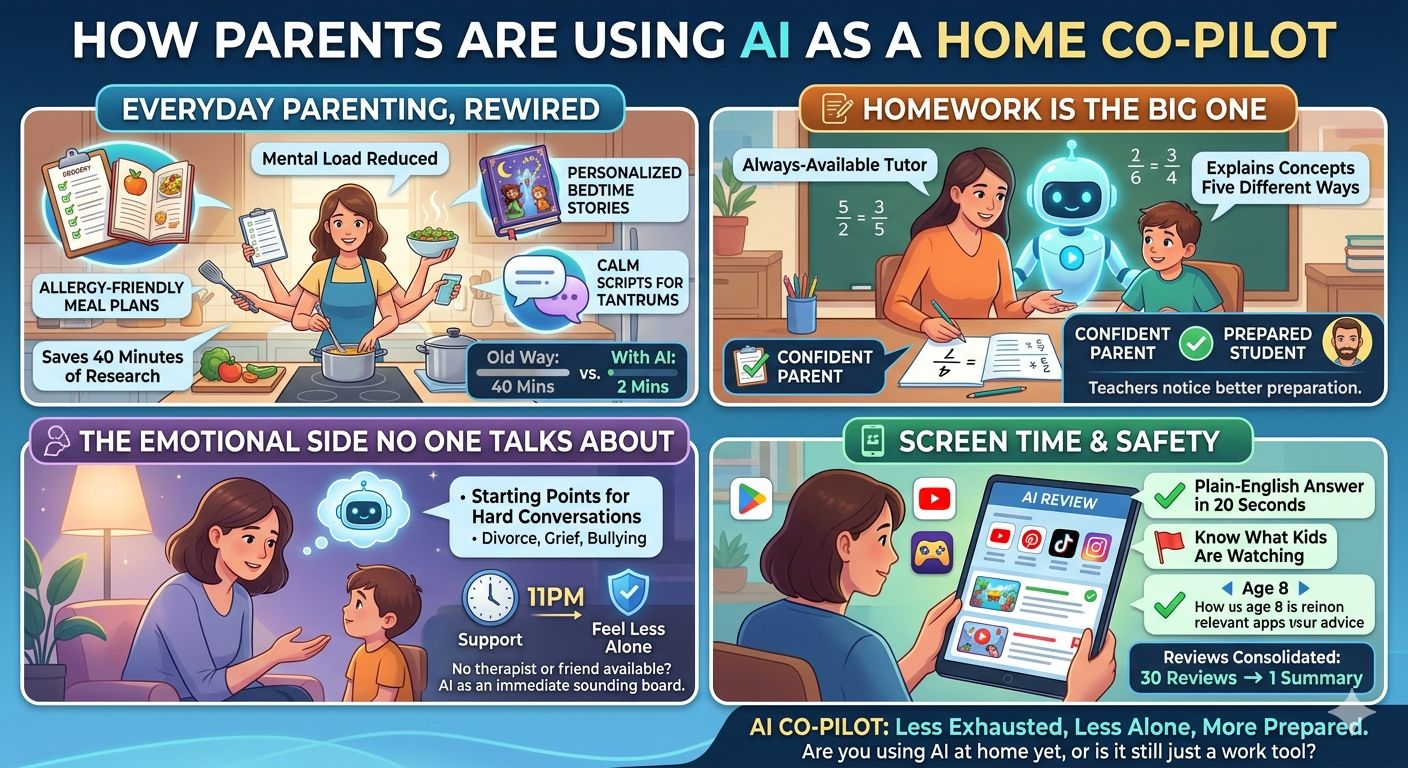
A mom in Ohio hasn't Googled a parenting question in six months. Her AI does it before she even finishes asking.
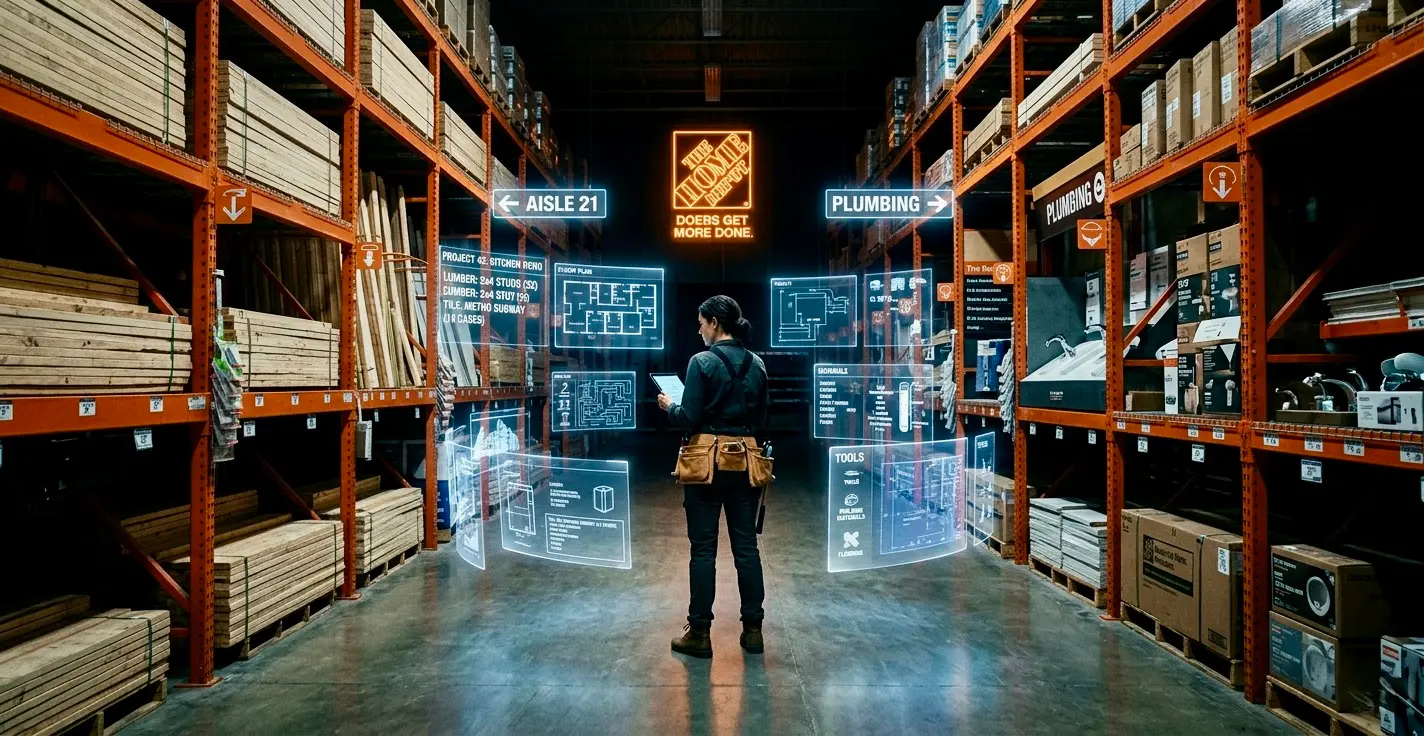
The $30,000 Question: How Home Depot's AI Just Made Contractors Nervous (And Homeowners Empowered)
testing
Free vs Upgraded
Start simple.
Grow with help.
Free gives you easy tools and prompts for daily life. The Vault gives you the full premium library plus member-only help while you learn AI.
Access The Vault
Upgraded membership
- Premium app code ready to copy and use yourself
- Premium prompts ready to copy and use yourself
- Full apps + prompts library in one place
- Member support while you learn and build (Vault only)
- Private group access
- More apps and prompts every month
Get a Custom App Built
No set price - talk with me
- Tell me what app you want built
- We plan features and timeline together
- Best if you want it done for you